Kleingers Plans for Utility Connection Under Streetcar Power Lines
The Kleingers Group recently created plans for the first underground utility connection installed under the new Cincinnati Streetcar while the overhead lines are energized.
Specifically, the Water Service Branch Plan created by Kleingers identifies the routing of a new water service line and the location of the bore pits required to tunnel under the streetcar line.
Like most projects in an urban setting, the routing of the new waterline had to be configured in a tight space while avoiding a number of existing utilities, all at various depths. The location of the bore pits also had to be chosen carefully to work around a large number of existing utilities.
The new water line, installed by Greater Cincinnati Water Works, will service a building currently under renovation by 3CDC.
Plans submitted to Greater Cincinnati Water Works were approved the same day, allowing work to begin quickly.
The project is expected to be the first of many to come that will require extra care to work around the tracks for the Cincinnati Streetcar.
4 Ways the Kleingers Group Will Make Your Next Traffic Count Better
The Kleingers Group recently acquired unmanned bird’s eye perspective video capture devices, a new way to conduct traffic counts. Rather than requiring a person to stand at an intersection, the new technology converts images to data using video collected through a battery-operated camera.
The benefits to you are:
- Access to Multiple Days of Data at No Extra Cost: A traditional intersection traffic count only collects one day of data. Sometimes something unexpected happens, such as a crash on a nearby street that diverts traffic and creates a high count. With video capture devices, The Kleingers Group has access to several days of data to ensure the traffic count is giving a representative picture.
- Counts at Abnormal Locations (such as Roundabouts) at A Reduced Cost: Busy roundabouts are notoriously hard to count because the person counting has to follow the car along its entire path through the roundabout. Often roundabouts require multiple people to conduct a count, raising costs. With video capture, costs don’t increase.
- More Information than Just Numbers: Sometimes traffic patterns need to be observed to get the full picture. An intersection may be too busy for a person to count the traffic and simultaneously make notes of needed observations. Now, video can be reviewed directly, allowing the engineer to make the necessary observations, often at a sped-up rate. The end result is more information to help you make smart decisions.
- The Ability to Review Data at A Later Time: Sometimes specific questions about existing conditions don’t arise until after the traffic count is finished. With video capture, The Kleingers Group can go back and review the video on file to answer new questions, saving a repeat field visit.
Read how The Kleingers Group is using new technology to create an innovative parking solution on Blue Ash Road or contact The Kleingers Group to discuss how we can use video capture and smart analysis to help solve your traffic or parking problem.
What’s the Back-Up Plan? Changing the Parking Scheme on Blue Ash Road
Backing out of 90-degree on-street parking into a busy road is generally recognized as a very dangerous parking maneuver. Drivers often can’t get a good view of oncoming traffic before pulling into it, leading to driver anxiety and accidents.
So when The Kleingers Group started a safety improvement study for Blue Ash Road in the City of Deer Park, the existing 90-degree on-street parking was a major concern.
The transportation and infrastructure group used Miovision Scout Data Collectors—a camera that records video for use in data collection and observation—to observe parking maneuvers along the corridor. With video capture, they were able to cost-effectively perform over a day’s worth of observations at a birds-eye view.
What they found was surprising: a good portion of drivers were already backing into the existing 90-degree parking spaces to enable themselves to be able to see when they pulled out later.
This knowledge led The Kleingers Group to consider reverse angle parking, an innovative solution.
Unlike traditional angled parking, in which drivers pull into a space head-on, reverse angle parking encourages drivers to drive just past an open space and back in, vastly improving visibility when they pull out. The result is parking that is safer for both drivers, cyclists, and pedestrians.
Although reverse-angle parking is less common than traditional angled parking, the data from video observation showed that a culture of backing into on-street parking already existed.
“We learned that a good portion of drivers were already making maneuvers similar to the changes we were proposing,” Traffic Engineer Dave Meyer said. “Reverse angle parking will allow much greater visibility when you are exiting a parking spot.”
Although education campaigns will still be necessary to acquaint residents with the alternative parking scheme, many drivers won’t have to substantially change their habits. By encouraging the remaining drivers to also back into their parking space, accidents should be reduced and parking will be safer for motorists, cyclists, and pedestrians.
The result is increased economic development—including visitors, shoppers, and diners—as people feel safer parking and, as a result, frequenting the area.
Improvements to Blue Ash Road are expected to be completed in 2019.
With Kleingers’ Help, Deer Park Vision Plan Wins Award
Congratulations to Jay Stewart and Tim Casto for their work on the Deer Park 2035 Vision Plan, which recently won the Frank F. Ferris II Planning Award in the Implementation category! The award honors local communities whose efforts have contributed to the elevation of planning principles, greater awareness of the value of planning and improved quality of life.
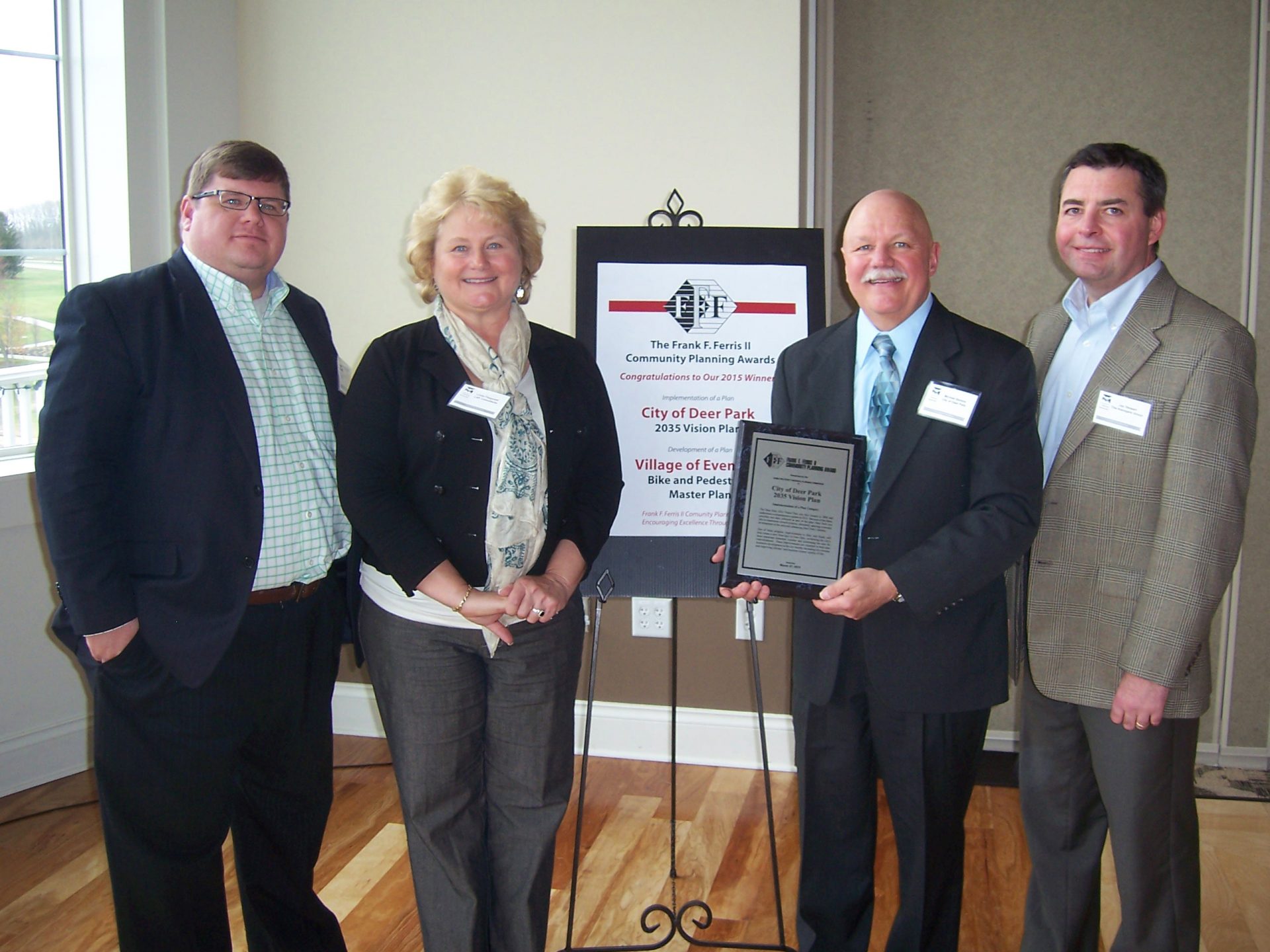 The Kleingers Group drafted the Vision Plan with a heavy emphasis on the implementation of the key priority action items. Some of the key action items identified in the plan and implemented since the plan’s adoption in 2008 include:
- Update of the City Zoning Code – Following on the heels of adopting the Vision Plan, the City’s first implementation project involved the re-write of the City Zoning Code.
- Blue Ash Road Streetscape Project – With the help of the City’s planning consultant,The Kleingers Group, the OKI Regional Council of Governments; Ohio Department of Transportation; and Hamilton County Engineers, funding has been secured for the $6.5 million Blue Ash Road improvement project.
- Development of a Capital Improvement Plan – Acting on one of the key recommendations from the Vision Plan, Deer Park created and adopted its first Capital Improvement Plan.
- Creation of a Community Reinvestment Area (CRA) Tax Incentive Program – In September 2012, the Deer Park Council designated the entire City as a Community Reinvestment Area (CRA) to provide tax incentives to property owners to encourage new investment.
- Creation of a Community Improvement Corporation (CIC) – Created in February 2011, the Deer Park Community Improvement Corporation (CIC) serves as the economic development arm of the City.
- Establishment of the Deer Park Business Organization – Beginning in 2009, the City spearheaded the creation of the Deer Park Business Association (DPBA).
The 2035 Vision Plan recognized that without a written master plan, the City of Deer Park would likely place itself at a disadvantage when presented with redevelopment and other growth related opportunities. The implementation of the Vision Plan’s priority goals and action steps will facilitate fiscal sustainability, maintain and enhance the quality of life for residents and businesses, preserve the City’s many traditional neighborhoods, and place Deer Park in a competitive position in the Greater Cincinnati economy.
Tim Casto, serves as Deer Park’s City Engineer. Jay Stewart, serves as a planning consultant to the city and is President of the Deer Park Community Improvement Corporation.