Skip to Main Content

Silverton Small Area Plan – Cincinnati Design Awards Winner

Silverton Small Area Plan wins Cincinnati Design Awards For Landscape Architecture & Community Planning

The Small Area Plan for the Village of Silverton promotes an active streetscape, provides for civic green space, and creates a more welcoming and walkable downtown. The design process included multiple stages of community engagement which began with a streetscape walk consisting of Village staff and focus group members to garner ideas for the future vision of the Plainfield Road streetscape. Public engagement continued with design charrettes and public open houses which were critical in creating the vision for the streetscape improvements for the diverse community.

To provide the Village of Silverton with a beautiful, pedestrian friendly streetscape promoting community building, the plan includes a Silverton gateway arch, a new pocket park, multiple streetscape parklets, a civic green with a pavilion for concerts, and community movie nights. Streetscape amenities include new streetscape pavement, pavers, planters, seating, art installations, lighting, parking, accessibility, bike racks, and Village branding.

The design was brought to life by creating extensive computer rendered 3D model videos. The rendered videos show the proposed improvements as if you were walking down the street. These videos helped to raise awareness of the plan and garner community support, promote economic development on the Village’s website, and helped successfully gain funding.

The Silverton Small Area Plan has created a meaningful impact on the community by creating a clear vision for the future streetscape and has already garnered additional funding to construct these proposed improvements.

Project Team

Urban Planner: Jay Stewart – Stewart Land Use

Landscape Architect:

Lynne Nischwitz – Lead Landscape Architect – The Kleingers Group; Jessica Rybolt – Landscape Designer; Dan Schneider – Landscape Architect

Other:

Tom Carroll – Silverton Village Manager

Read more about the award winning Silverton Small Area Plan at CincinnatiDesignAwards.com

Kacie Jane Park Ribbon Cutting

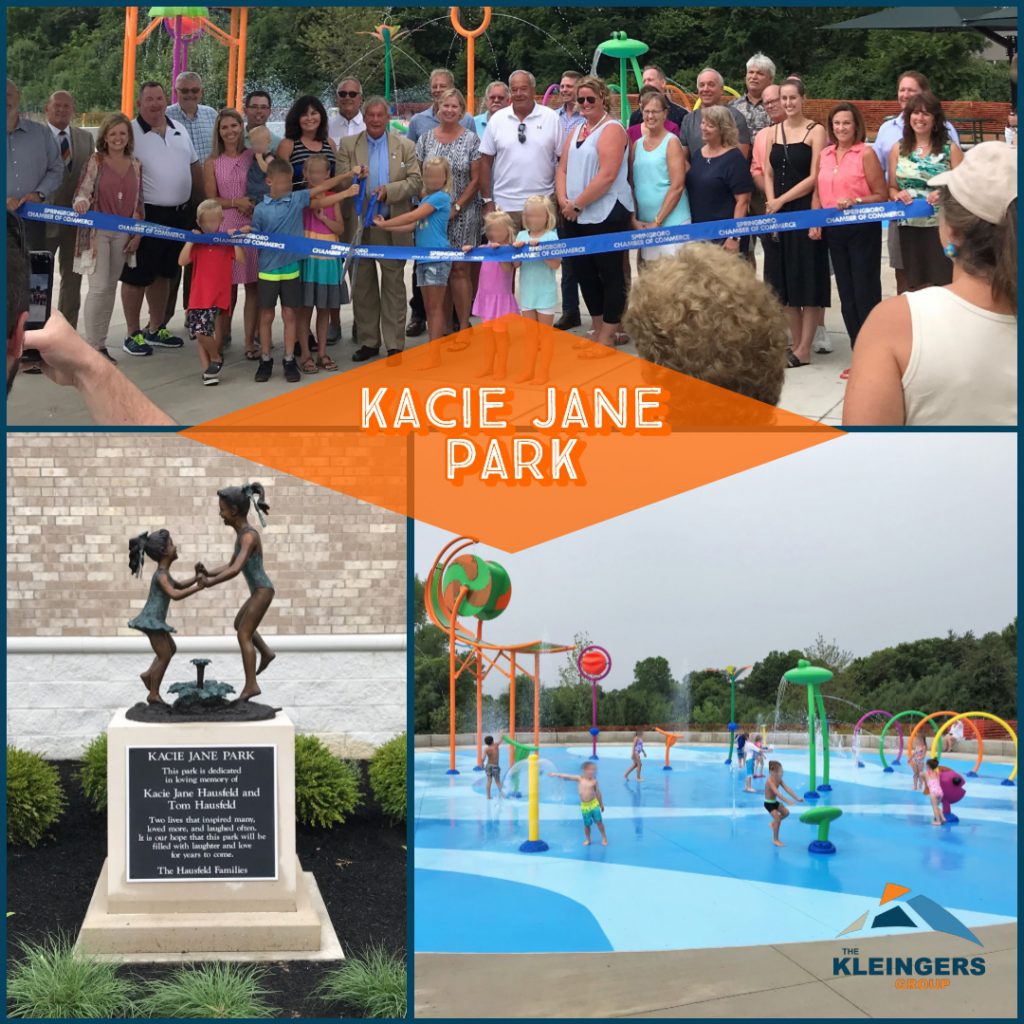
Yesterday, The Kleingers Group attended the ribbon-cutting ceremony at the Kacie Jane Park in Springboro that pays tribute to the memory of Kacie Jane and her father Tom. Our team provided the master planning and construction documentation for this 4,000 SF splash park. This is our first big splash pad and features 15 different spray group activities. The Mayor, City Council members, Clearcreek Township officials, Springboro Chamber, and the Hausfeld Family celebrated the dedication of the park to the City. This project is building a better community by providing a space for other families to have fun and laugh together. Phase 2 of incorporating playgrounds will be constructed next year.
 

10 Things to Consider When Planning a Sports Park

It’s not every day that an Owner takes on planning a 100+ acre sports park, but when the scenario arises, The Kleingers Group brings proven experience to the team. Over the years, Kleingers has designed a number of large-scale sports parks and has found that many of the same considerations tend to come up during our design process. We would like to share with you what to consider before you take on your sports park design.

1. Connect to Existing Community Assets

Creating transportation linkages to other community resources such as parks, schools, YMCAs, and more will encourage participation at the new development. Pursue ways to blend the new park with its surroundings and work with neighbors and stakeholders to build support for the project. Leverage connections through existing infrastructure like trailways, complete streets, and other multi-modal systems will provide easy access for bicyclists and pedestrians who visit the facility.

2. Create a Site that is Safe, Easy to Use, and Navigate

Speaking of connecting the site with pedestrians, it’s also important to design ways to keep them safe, especially from vehicular traffic. Maintain separate vehicle travel zones and pedestrian travel zones when possible and provide for safe and clearly marked crosswalks to help minimize conflicts. Branding, wayfinding, and creative use of landscape theming will help visitors with vehicles travel to their destination within the site more efficiently while minimizing user frustration.

Oftentimes, large sports complexes lack adequate wayfinding due to oversight or budget concerns. Proper wayfinding design can help users get to where they need to be while also creating a recognizable brand for the sports park and the associated owner.

3. All Sports Park Owners are in the Parking Business

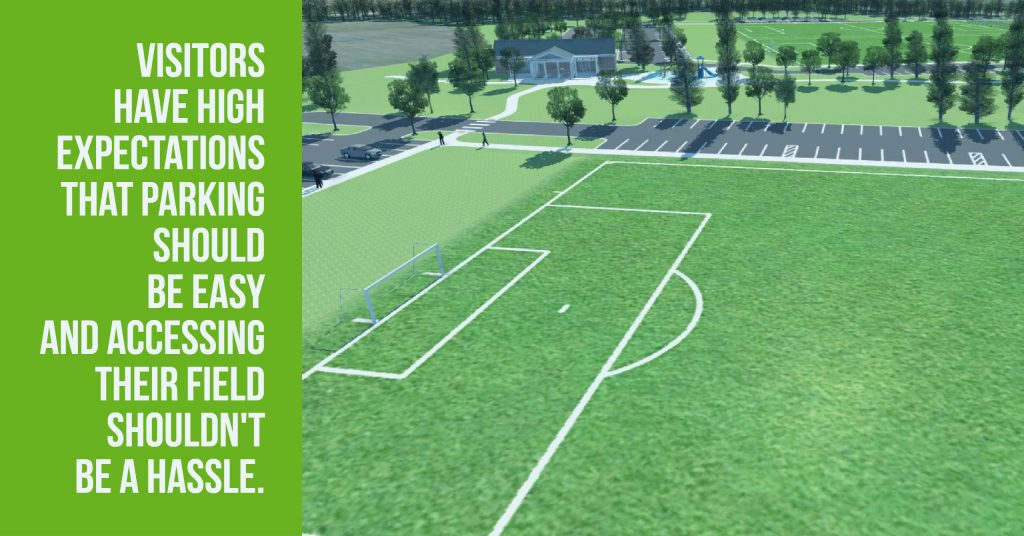
Did you know that many competitive organizations that bring tournaments to sports parks require minimum parking per event? Organizers hosting tournaments require anywhere between 50-100 spaces per field, some require even more. Believe it or not, sports park owners are in the parking business. Visitors have high expectations that parking should be easy and accessing their field shouldn’t be a hassle. Tournament organizers must meet the demands of their clients, which means balancing the site’s infrastructure is important to everyone’s bottom line. Planning for enough parking close to destination points within the design allows for better traffic flow and provides better ADA access throughout the site.  The site layout needs to balance ease of access without being interrupted by large parking areas, or losing the vibrancy of an active and energized park.
4. Plan for Flexibility: Master Planning the Site for Optimum Use

Creating a park with the most flexible layouts will mean more options for end-users. Engineering the field grading is a key component. Fields should be carefully engineered to accommodate high-end games and large events with the ability to host smaller games within the same space without compromising the playable area, including crowns and field orientation.

Master planning a complex for multiple sports provides flexibility when attracting special events. Understanding how to plan for and design sports parks for flexibility amongst sports, whether soccer, football, lacrosse, rugby, Australian football, ultimate frisbee, baseball, softball, or cricket will attract a larger audience. Knowledge of national sports trends will allow the field designer to guide a client through the planning stages while meeting their needs and measured desires within the area.

5. Coordinate with Local Municipalities

Working with local interests and shareholders during the design process helps to ensure that everyone has a voice in the process of designing the sports park. Creating opportunities for partnerships early will help generate buy-in from key stakeholders and community members. Our experience in working through this relationship helps guide programming, affordability, and ultimately desired priorities.

6. Plan for Extra Traffic in the Area

More often than not, any new development brings additional traffic to a site. Traffic engineers can provide traffic studies to better understand current traffic conditions and anticipated changes and recommendations.
7. Sports Engineering is Key: Grading, Drainage & Field Performance Will Keep Them Coming Back

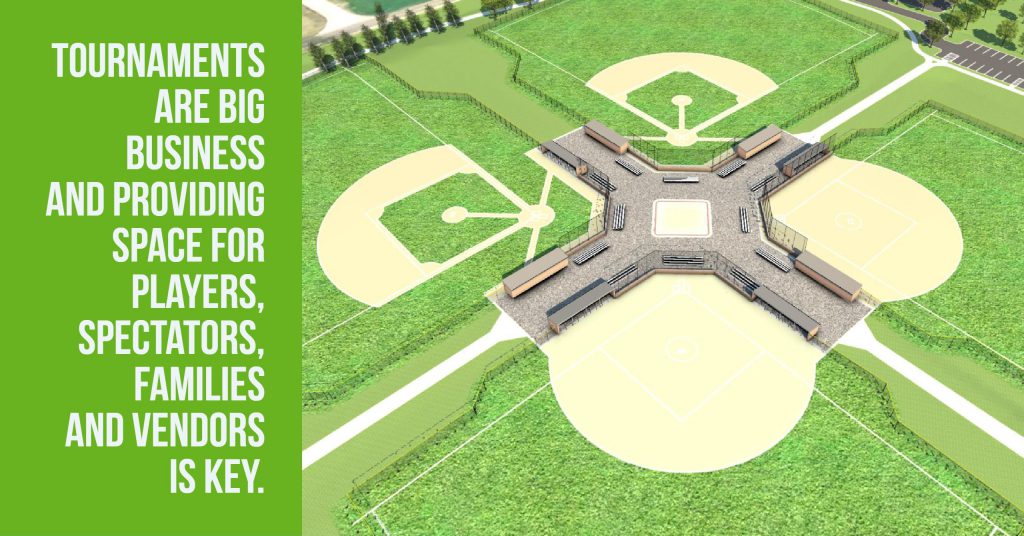
Creating space for tournaments is big business and retaining that business helps any sports park be successful. If the grading, slopes, drainage, playing surfaces, and other amenities are not designed properly, tournament organizations will take their business down the road to the competing sports park. Competitive organizations have a business to run and their business model depends on feedback from players and parents who use the fields, facilities, and park amenities at these events. Positive survey feedback will increase the chances that they return again for another event.

8. Plan for Attendees Who are not Players or Spectators

A large portion of the sports park business is creating a fun and comfortable experience for attendees. Creating spaces, such as playgrounds, within eyesight of a group of playing fields keeps that family with one child playing in the game and another bored on the sideline entertained and comfortable. Providing a trail system allows for visitors to take a break between tournament games, connect to another game across the complex, or meander to a ‘hub’ with concessions and restrooms nearby. Trails also appeal to pedestrians and bicyclists across the community.

9. Create a Space for Vendors

An often-overlooked element of the sports complex business is providing adequate space for vendors who are often on hand during a sporting event selling sports equipment, promotional items, and more to parents and other attendees. Creating ‘vendor zone’ spaces convenient to tournament sites is a key selling point to those looking to bring competition to the area.

10. Plan for Championships and Celebrations

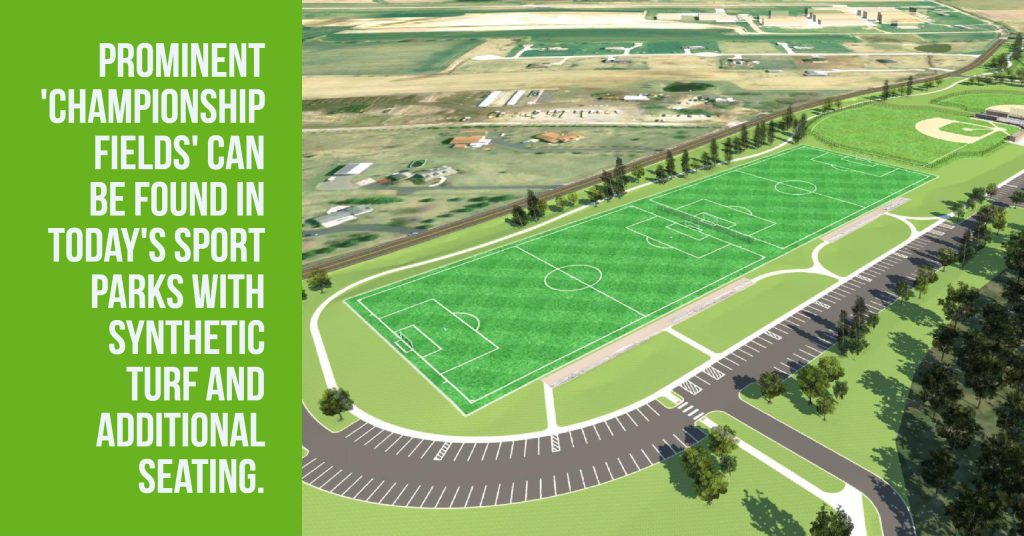
Another trend in design that we see is the inclusion of championship fields. These higher-quality fields, sometimes utilizing synthetic turf, are designed with more seating and are typically located in prominent areas of the complex to draw more crowds as competitions wind down. Additionally, we see the integration of amphitheater spaces where teams celebrate their accomplishments with awards ceremonies.
Summary

These design considerations are a fraction of the items to explore when creating a sports park. At Kleingers/Sportworks, we understand the business of sports parks, the competition that takes place inside and outside the park, and the investment owners take in creating these opportunities for revenue. We also understand good engineering, traffic, sports field engineering, survey and landscape design, and the importance of getting all of these things done right for the bottom line and ultimate success of any sports park complex.

Tree Donated Celebrating 2017 World Landscape Architecture Month
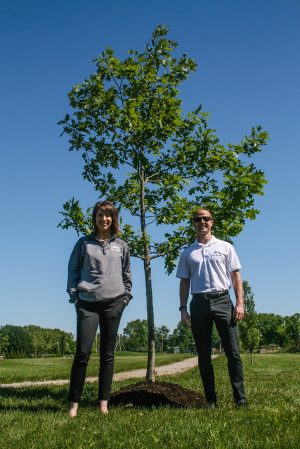
Lynne and Ryan, members of Kleingers' Landscape Architecture Studio, on hand for the tree installation.

Lynne and Ryan, members of Kleingers’ Landscape Architecture Studio, are on hand for the tree installation.

In celebration of 2017 World Landscape Architecture Month (WLAM), The Kleingers Group generated an online social media campaign to raise awareness for the landscape architecture profession. The campaign gave social media followers the opportunity to vote for their favorite community park designed by Kleingers’ landscape architects. The park with the most votes would receive a shade tree donated by the Kleingers Group. During the month-long landscape architecture celebration, the campaign reached over 10,000 people online and Miller Ecological Park in Lebanon, Ohio was selected to receive the donated tree from Kleingers.

The Miller Ecological Park consists of many sustainable features including a permeable parking lot, bioswales, and many diverse plantings to attract birds and wildlife. Many projects within the park have been donated such as bird boxes, a wildlife blind, an informational kiosk, benches and bleachers, a maintained walking/running trail, bridges, and a gaga pit.

“The City is very thankful for the donation of a beautiful tree in Miller Ecological Park, by Kleingers, as we continue to work on enhancing the park’s natural environment.”
– Scott Brunka, Deputy City Manager, City of Lebanon

The Kleingers Group remains astounded by the level of support each community fostered during our small campaign. We can only hope this effort will inspire others to give back within their own communities. Thank you to all who voted, donated, and celebrated #WLAM17 with us. We look forward to celebrating again next year!

To learn more about the profession and Landscape Architecture Month, visit https://www.asla.org/contentdetail.aspx?id=45783.

Kleingers awarded ‘Cincinnati Design Award’ for work at Miami

For the second year in a row, The Kleingers Group was the proud recipient of a Cincinnati Design Award in the landscape architecture category.

This year, Kleingers won the honor award for its work on Miami’s western campus.

The goal of the Cincinnati Design Awards is to recognize high-quality design in the regional community and to educate the general public about the benefits of supporting quality design. Kleingers was honored to be listed among the top designers in the region.

“We really enjoyed working with Miami and the project team and are really pleased with how well it all came together,” said Lynne Nischwitz, Kleingers’ Landscape Architecture Studio Leader. “We were especially proud of how the hardscape and softscape weave together and thought it was really spectacular that we were able to expand the University’s Horticulture Walk.”

At the event, the judges thanked Kleingers for creating such a pleasing landscape.

The project began in 2014 when the University constructed three new residence halls, a dining hall, a geothermal energy plant, and two ponds.

The University’s vision for the Western campus landscape was to create a cohesive, naturalistic, and sustainable landscape that would immerse students into nature. Kleingers worked closely with the University to bring the vision to life.

The final design expanded the University’s horticulture walk, provided a central large gathering space, passive gathering spaces for each residence hall, pedestrian connections across campus, stream restoration, and the new 150’ long bridge that will look like the historic, iconic cobblestone bridges that have existed on this portion of Miami’s Western campus for many years.

Kleingers conducted civil engineering, survey and landscaping at Miami University in Oxford,

The landscape and hardscape spaces ‘weave together’ such that colorful naturalistic plantings danced into plaza areas while these plaza areas disintegrated into beautiful swathes of planting colors and textures. The interplay of movement between the prairie-style landscape and the hardscape plazas and walks unifies the entire Western campus landscape and indulges students and visitors in nature’s beauty.

Each area of the design was carefully thought out and plays a part in fulfilling the University’s vision.

New Plantings

The extensive and unique plant list includes native trees, ornamental grasses, and perennials that provide seasonal bloom and sweeping, dramatic, and naturalistic views. These plantings were extremely important to the University as they allowed for the expansion of the University Horticulture Walk.

Plantings include over 50 types of trees and a vast array of perennials and grasses. Trees included many Oak varieties such as Bur Oak, Sawtooth Oak, White Oak, Overcup Oak, Chinkapin Oak, Willow Oak, and Shingle Oak, as well as Shagbark Hickory, Dawn Redwood, Sycamore, Hardy Rubber Tree, Katsuratree, Cottonwood, Gingko, Black Tupelo, Amur Corktree as well as multiple Maple varieties to name a few. Ornamental grasses included Little Bluestem, Ice Dance Carex, Northern Sea Oats, and Autumn Moor Grass and perennials included Coneflower, Blazing Star, Russian sage, and Salvia and Sedum varieties.

Stream Restoration

The detailed design of the stream restoration creates dramatic views from the new and historic pedestrian bridges by creating pools of water in-between stream riffles. The naturalistic plantings along the stream contribute to the overall low maintenance field of native prairie grasses with pops of color.  Boulders of varying colors were utilized at different points along the stream and positioned along strategic portions of the pond edge to further unify the western campus aesthetic and create rhythm with the architecture.

Large Gathering Spaces

The central large gathering space consists of a sunken lawn oval with amphitheater seating that diminishes into the ground, further enhancing the seamless transition of hardscape and softscape. This central gathering space provides the opportunity for organized concerts or casual use, allows for zero edge handicap accessible entry into the sunken ‘green’, and marries the hardscape and the residence hall architecture through rings of blue/black seeded aggregate that radiate out from the ‘central green’ oval and continue through the buildings and out into separate passive outdoor patio spaces.

Reviewed by a blind jury from all over the country, Kleingers was extremely honored to be recognized for its work creating a natural, cohesive and sustainable landscape.

What Plants to Plant to Beat the Heat?

As we head into the summer months and temperatures continue to rise, we often get asked, “What plants should I install that will survive and perform well throughout the summer?”  As Landscape Architects, one area that we specialize in is planting design.  There are many considerations to take into account when selecting the appropriate plant material – size, sun exposure, drought tolerance, salt tolerance, color, time of year that it flowers, and so on.  Whether a project will have irrigation installed or not is another big factor to consider, especially during the summer.  We study all of these plant characteristics to select the correct combination of plants for the specific locations on a project.

Here are some recommendations for plants that are not only drought-tolerant and heat resistant, but could also aesthetically meet the needs of your project:

Perennials:

Landscaping at GE EPISCENTER in Dayton

The plants chosen by The Kleingers Group for the landscaping at the GE EPISCENTER in Dayton are designed to look great even during the heat of the summer.

1. Moonbeam Coreopsis – Coreopsis verticillata ‘Moonbeam’

Showy yellow flowers with a light airy texture. Tolerant of a wide variety of conditions including drought and heat.

2. Walker’s Low Catmint – Nepeta faassenii ‘Walker’s Low’

Showy periwinkle blue flower spikes with fragrant grey-green foliage. Attracts hummingbirds and butterflies.

3. Black Eyed Susan – Rudbeckia fulgida

Bright yellow flowers and a bold upright texture make this plant pop in any landscape. An extremely hardy plant with seed heads that persist adding winter interest to the landscape.

4. Blazing Star – Liatris spicata

Vibrant pink flower spikes emerge in late summer/early fall. This plant attracts an abundance of wildlife anywhere it is planted!

purple coneflower

Purple Coneflowers

5. Purple Coneflower – Echinacea purpurea

Large pinkish-purple blooms sit atop handsome dark green foliage. Extremely durable with many varieties available.

6. Autumn Joy Sedum – Sedum ‘Autumn Joy’

Dark pink blooms emerge in fall turning into a coppery color that lasts all winter long. Blooms sit on top of broad succulent stems and leaves.

7. Russian Sage – Perovskia atriplicifolia

Tall, airy, spike-like flower clusters create a lavender blue cloud in the landscape. Flowers sit atop a finely textured aromatic foliage. Extremely drought tolerant, hardy plant.

8. Daylily – Hemerocallis ‘Stella de Oro’

Bright yellow flowers emerge above a clump of arching, linear, blade-like leaves. Great in masses as it provides color all year long.

 Ornamental Grasses:

Feather Reed Grass

Feather Reed Grass

1. Feather Reed Grass – Calamagrostis acutiflora ‘Karl Foerster’

An ornamental grass with strong upright vertical lines. The plant is valued for its early bloom time and strong ability to adapt to many growing conditions.

2. Switchgrass – Panicum virgatum

An upright landscape grass with lovely blue-green foliage. In late summer, light, airy, wheat-colored flowers emerge.

 Shrubs:

St. John's Wort

St. John’s Wort

1. Shrubby St. John’s Wort – Hypericum calycinum

A widely used low-growing evergreen shrub. The deep green glossy foliage is an attractive backdrop to the bright yellow pincushion-like flowers that emerge in early summer.

2. Blue Chip Butterfly Bush – Buddleia ‘Blue Chip’

Low-growing attractive shrub with great drought tolerance. The shrub features intense blue flower spikes that begin in June and last all season long. This shrub is incredibly fragrant and attracts many wildlife species.

As you can see, selecting the proper plant for the proper location is critical to plant survival and growth. Let us assist you in your next design!


Advocating for Landscape Architecture

Landscape Architect Lynne Nischwitz met with Senator Rob Portman to advocate for the profession. Landscape Architect Lynne Nischwitz met with Senator Sherrod Brown to advocate for the profession.Last week, Lynne Nischwitz, the Landscape Architecture Studio Leader at the Kleingers Group, traveled to Washington DC as part of her role as Vice President of the Ohio American Society of Landscape Architects (ASLA) to advocate for landscape architecture and causes important to the profession.

Each year ASLA sends landscape architects from across the country to Washington DC to raise the visibility of the profession with legislators and help promote the solutions that landscape architects can help provide to various national problems.

This year, the group was advocating for three things:

  1. Ensuring that bicycle and pedestrian paths and walkways continue to receive support in the latest Transportation Alternatives Program and are not subject to the same regulations as large highway projects.
  2. Protecting the Land and Water Conservation Fund which provides grants supporting the local park, conservation, trail, and recreation projects.
  3. Promoting the National Park Service Centennial challenge, ensuring money is available for the maintenance of the nation’s national parks.

The group also spoke about the importance of licensure in the landscape architecture profession. The education, experience, and examination required to earn a license ensures that licensed landscape architects can “keep the public safe from hazards, protect and maximize the use of natural systems and resources, and prevent damage to public or private property from changes in the built environment”, according to ASLA.

Lynne and fellow ASLA members met with Senator Rob Portman and Senator Sherrod Brown and Lynne also met with a representative from Steve Chabot’s office.

To learn more about the 2015 Advocacy Day or about the issues visit www.ASLA.org.

Landscape Architecture Month: Designing a Better Community

April is World Landscape Architecture Month — a time dedicated to promoting landscape architecture to students and educating others about what it means to be a landscape architect.

Landscape architects are the people responsible for designing the parks, plazas, streetscapes, and green spaces that make the outdoors healthy, sustainable and enjoyable. At the Kleingers Group, we are proud of the role our landscape architects play in moving communities forward.

This month, we asked our landscape architects about why their profession is important, why they got involved, and what projects count among their favorites.

1. Why Are Landscape Architects Important?

“Landscape architects are important because they have the ability and skills to bring many different people and professions together to create improvements for the community.  LA’s look at projects from a holistic approach, searching for the best solution.” – Michael

“Without landscape architects our world would be boring! Landscape architecture is not just about making things look pretty, its about creating and transforming spaces that initiate lifestyles and allow users to get outside and enjoy quality designed spaces. Landscape architects shape our built environment, they create spaces that function but are also aesthetically pleasing and designed to enhance the user’s quality of life.” – Ryan

2. What Inspired You to Become a Landscape Architect?

“I was inspired to enter the profession of landscape architecture when my parents decided it was time to spruce up their house. I was in middle school when they hired a landscape architect to completely transform their outdoor spaces. I immediately became interested in the process from reviewing plans, to choosing materials, to looking at plants. It wasn’t until I saw the finished product and the amazing transformation happen that I knew I wanted to do this for the rest of my life. After the transformation, the way we used our outdoor spaces changed. We no longer used the inside of our house for the majority of our activities, my family was outside as much as possible enjoying the amazing spaces that were created. I knew I wanted to design these spaces so everyone could have as much fun enjoying nature as I have.” – Ryan

“I first learned about the profession of landscape architecture from my dad, as he had graduated from Ohio State with a degree in Landscape Architecture.  From listening to him talk about the profession, I knew that there was a lot more to landscape architecture than just designing planting plans. It was interesting to hear his stories about happenings that had occurred in the studio while drawing or something that happened in the field. It all sounded exciting. Because my dad graduated in landscape architecture from Ohio State,  I remember seeing an alumni brochure he received in the mail showing the landscape architecture studio space. That sealed the deal for me, I thought it would be really cool to work in a creative studio environment.” – Lynne

“My senior year of undergrad, I took an environmental design class where I learned about landscape architecture for the first time.  It combined many of my interests of design, the outdoors, etc. and the rest is history.” – Michael

3. Do You Have a Favorite Project that You Have Worked On?

“My favorite project I worked on was the Japanese American National Museum project in Los Angeles. It is my favorite project because it was the first project I worked on from concept design all the way through construction administration. I also loved the design of the project as well as the scale.  It was also fun because George Takei, Sulu, from Star Trek was on the board of trustees of the Japanese American National Museum. I remember him being at a couple of meetings. I never watched Star Trek, so, I didn’t really care, but, it was funny to come back to the office and everyone would ask if George was at the meeting because they were Star Trek fans. The project also incorporated a fountain designed by Robert Murase.” – Lynne

“One of my favorite projects is one of my earliest ones that I did while working with LDR/HNTB in Maryland, called Carroll Creek.  It transformed a desolate flood control infrastructure into an urban park, generating new business and residences for the city of Frederick, MD.” – Michael

Miami University Western Campus. Example of Landscape Architecture in Oxford, Ohio.

Miami University Western Campus

“My favorite project I have worked on would be Miami University’s Western Campus. It was a large project with many different aspects. This project was a fast-paced project that allowed me to express a lot of creative freedom. Because the project was so fast paced, I was able to see how the design translated from paper to a real life application while the design was still fresh in my mind, which is pretty rare in our profession. Also, most my family members went to Miami University, so when we go up to oxford it also allows me take them to the project and brag about how cool the finished product is!” -Ryan

4. What Is Your Favorite Part of The Job?

The nearly completed rooftop plaza at DunnhumbyUSA. Landscape Architecture in Cincinnati.

The nearly completed rooftop plaza at DunnhumbyUSA.

“My favorite part of being a LA is seeing the physical impact on the community that our designs/projects have.  To go to a public project (or a private one) and see people using it is the best reward.” – Michael

“I really enjoy most aspects of the profession because it is ever changing. I would say my absolute favorite portion would be the creative freedom we, as designers, are allowed. No two projects are alike, so it allows us to create unique new spaces with each project. The job is never monotonous and always keeps you interested and on your toes!” – Ryan

5. What Have You Done to Educate Others About the Profession?

“I serve as the Ohio Chapter VP of ASLA and therefore, I am working with our state legislators on advocacy for the profession. In fact, next week,  I go to Washington D.C. to speak to our senators and representatives about issues relative to the landscape architecture profession. I have visited a class of kindergarteners and talked to them about landscape architecture and what we do as professionals. To show them in a way that they can relate, I asked them what they liked about parks and wrote down the list of things they liked to do at parks. Then, in a charrette style, right in front of them, I designed a park with all the elements they love. While doing so, I opened up their eyes that not only do  landscape architects think about the fun stuff in a park, such as the playstructures, but also plan how the overall park is master planned and designed. For example, how you get to a park, (driving, walking or riding your bike), restroom facilities, parking areas, shade, and seating etc. and how all these elements work together.” – Lynne

“It is a constant education to explain to people that LA’s do more than backyards, golf courses or plants.  To help get that message out there, I have spoken at conferences, public meetings, and just converse with people in general.” – Michael